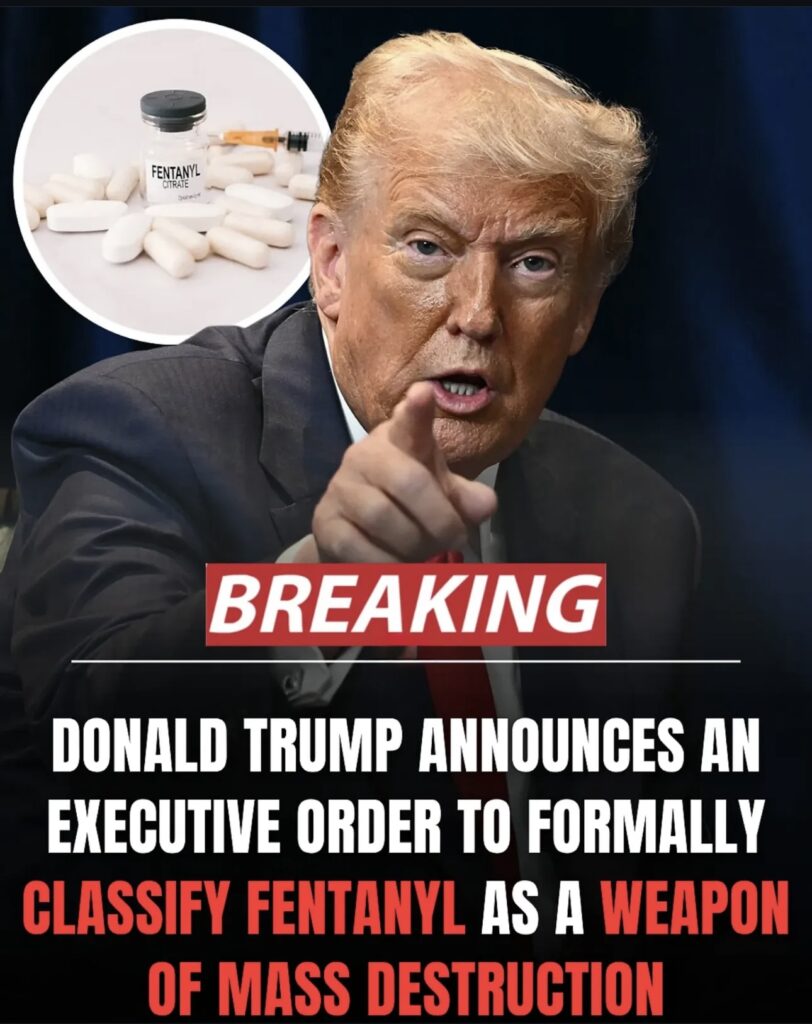
Trump Signs Executive Order Classifying Fentanyl as a ‘Weapon of Mass Destruction’
Washington, D.C. — On December 15, 2025, U.S. President Donald J. Trump signed an unprecedented executive order formally designating illicit fentanyl and its core precursor chemicals as weapons of mass destruction (WMD) — reframing the nation’s ongoing opioid crisis as a national security threat on par with chemical weapons. 
Speaking during a White House ceremony, Trump said “we’re formally classifying fentanyl as a weapon of mass destruction, which is what it is,” asserting that the synthetic opioid’s lethality — even in minuscule amounts — has devastated American communities. 
What the Executive Order Does
The directive declares that illicit fentanyl and certain precursor chemicals “are closer to a chemical weapon than a narcotic” and states that the manufacture and trafficking of these substances pose a grave threat to national security. According to the official text, just two milligrams — roughly equivalent to 10–15 grains of table salt — can be lethal.
Under the order’s provisions:
• The Attorney General is instructed to aggressively pursue investigations, prosecutions, and enhanced sentencing in fentanyl trafficking cases.
• The Secretary of State and Treasury are directed to pursue actions targeting financial networks and assets used by those involved in the production and distribution of illicit fentanyl.
• The Defense Department and Department of Homeland Security are asked to determine how national security resources might support fentanyl enforcement and response efforts. 
A Shift to National Security Framing
Historically, “weapons of mass destruction” refers to nuclear, biological, or chemical weapons capable of large-scale harm. Experts caution that this designation for fentanyl — a powerful synthetic opioid — is symbolic and administrative, rather than implying the drug is a literal military weapon used by hostile states. Critics argue the shift could blur the line between public health and national security responses. 
Proponents within the Trump administration say the classification enables a broader toolkit to combat trafficking networks and dismantle the supply chains that flood the U.S. with deadly narcotics. Officials also frame the move as a way to bolster international cooperation and intensify pressure on foreign actors involved in precursor chemical production. 
Response and Controversy
The order has drawn a mixed response. Supporters praise it as a bold escalation in the fight against cartels and criminal organizations that profit from fentanyl’s spread. Meanwhile, critics — including drug policy analysts and human rights groups — warn it could militarize law enforcement, heighten the risk of abusive tactics, and further sideline treatment-oriented approaches to addiction. 
Internationally, the move has also attracted attention, especially given the Trump administration’s emphasis on targeting precursor chemicals sourced from abroad. The designation may influence future cooperation with countries like Mexico and China, which have been focal points in fentanyl supply discussions. 
Looking Ahead
As this executive order takes effect, its practical implications — from law enforcement strategies to diplomatic negotiations — remain to be fully seen. While the classification does not alter fentanyl’s inherent chemical properties, it signals a dramatic policy shift in how the U.S. government perceives and plans to confront one of the deadliest drug crises in the nation’s recent history.