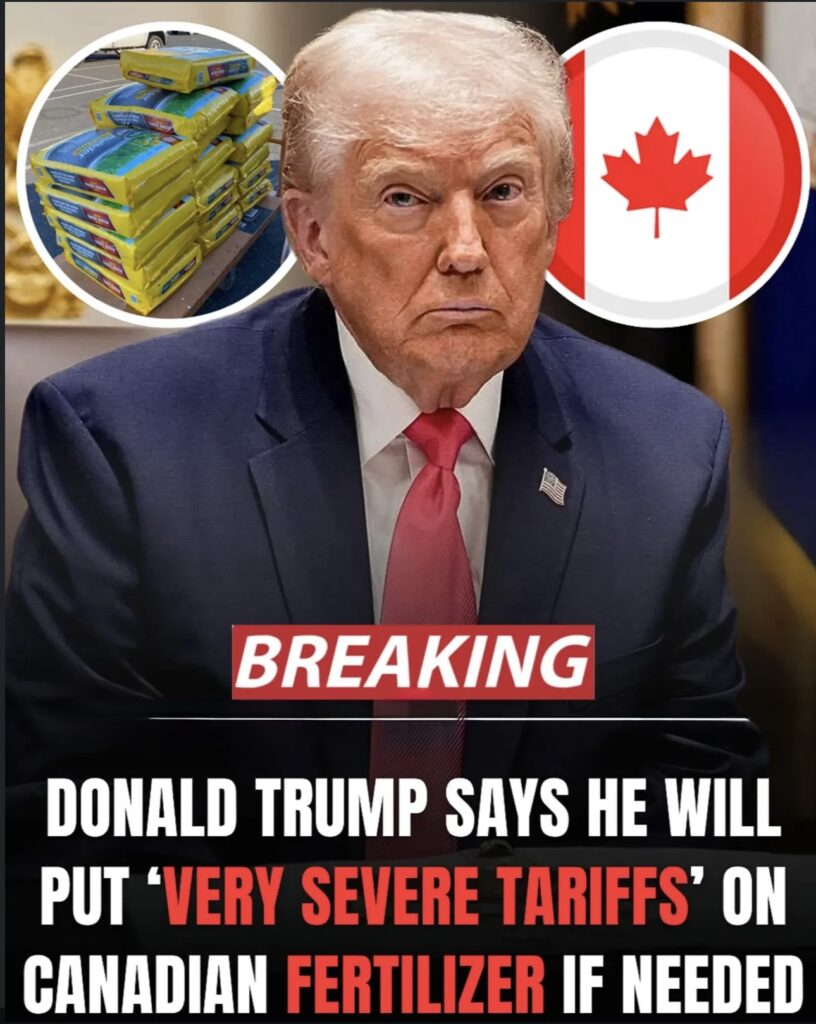
President Donald Trump has once again focused attention on agricultural trade, indicating that the United States might impose tariffs on fertilizer imported from Canada if deemed necessary. The remarks came during a White House event where Trump unveiled a $12 billion support package for U.S. farmers, aimed at easing rising costs and mitigating market pressures.
Trump emphasized the importance of strengthening domestic fertilizer production while ensuring American farmers have the resources they need to maintain crop yields. During his remarks, he noted that tariffs on Canadian imports could be applied as a measure to encourage local manufacturing and reduce dependence on foreign sources. He described these potential tariffs as “very severe” if we have to.”
Canada supplies a substantial portion of fertilizer used in U.S. agriculture, including potash and other essential nutrients. This supply plays a critical role in supporting crop production across the Midwest and other key farming regions. Industry experts note that imposing high tariffs could disrupt the supply chain, increase costs for U.S. farmers, and create uncertainty in the agricultural sector.
Canadian officials and producers responded cautiously, stressing the interconnected nature of the North American fertilizer market. Leaders from Saskatchewan, a major production hub, highlighted that tariffs could impact both countries’ agricultural economies. Trade observers point out that the United States–Mexico–Canada Agreement (USMCA) already provides a framework for cross-border fertilizer trade, making abrupt policy changes potentially complicated.
While Trump’s statements signal a willingness to use tariff threats to achieve policy goals, analysts suggest that any actual imposition would require careful consideration due to the reliance of American agriculture on Canadian fertilizer. Experts warn that steep tariffs could unintentionally raise input costs for U.S. farmers in the short term, counteracting some of the benefits of the announced farm support package.
The $12 billion aid initiative includes direct payments to producers and programs aimed at offsetting higher production costs. It comes amid ongoing challenges for American farmers, including elevated input prices, international trade tensions, and fluctuating commodity markets. By pairing potential tariff measures with financial support, the administration frames a strategy intended to both protect domestic interests and encourage self-sufficiency in agricultural production.
Observers on both sides of the border are watching closely. Canadian officials stress the need for dialogue and negotiation to avoid market disruptions, while U.S. farmers and advocacy groups are assessing how these combined policies could affect production decisions in the coming seasons.
Trump’s comments highlight the continuing focus on trade, domestic production, and agricultural policy. While the possibility of tariffs has drawn attention and concern, the broader context of farmer support measures indicates that the administration is attempting to balance protectionist tactics with financial aid to stabilize the sector.
The situation remains fluid, with both policymakers and industry leaders monitoring developments to determine whether rhetoric will translate into action and how any changes might influence the broader North American farming economy.