Here is a longer, expanded version of the story with richer detail and a steadier narrative rhythm. This version is crafted for a three to five minute read.
They didn’t learn her name until much later. Before that moment, she was only a misshapen silhouette pressed against the edge of a Missouri road, barely distinguishable from the litter and torn fabric that gathers along rural highways. Drivers passed without slowing, convinced they had seen nothing more than a discarded blanket fluttering in the dust.
Up close, the truth became impossible to ignore. What looked like debris was a dog so heavily matted that her body had taken on a distorted shape. Thick layers of fur hung from her sides like soaked wool, weighing her down and pulling at her skin every time she tried to move. Her steps were slow, machine-like, and strangely quiet, as if she had learned long ago that movement rarely led to relief.
When rescuers finally approached, she didn’t startle or attempt to escape. Instead, she froze in place. The absence of fear or fight was its own kind of heartbreak. It suggested a life spent so thoroughly in neglect that even self-preservation had become secondary to endurance. In her stillness, you could see the fatigue of years.
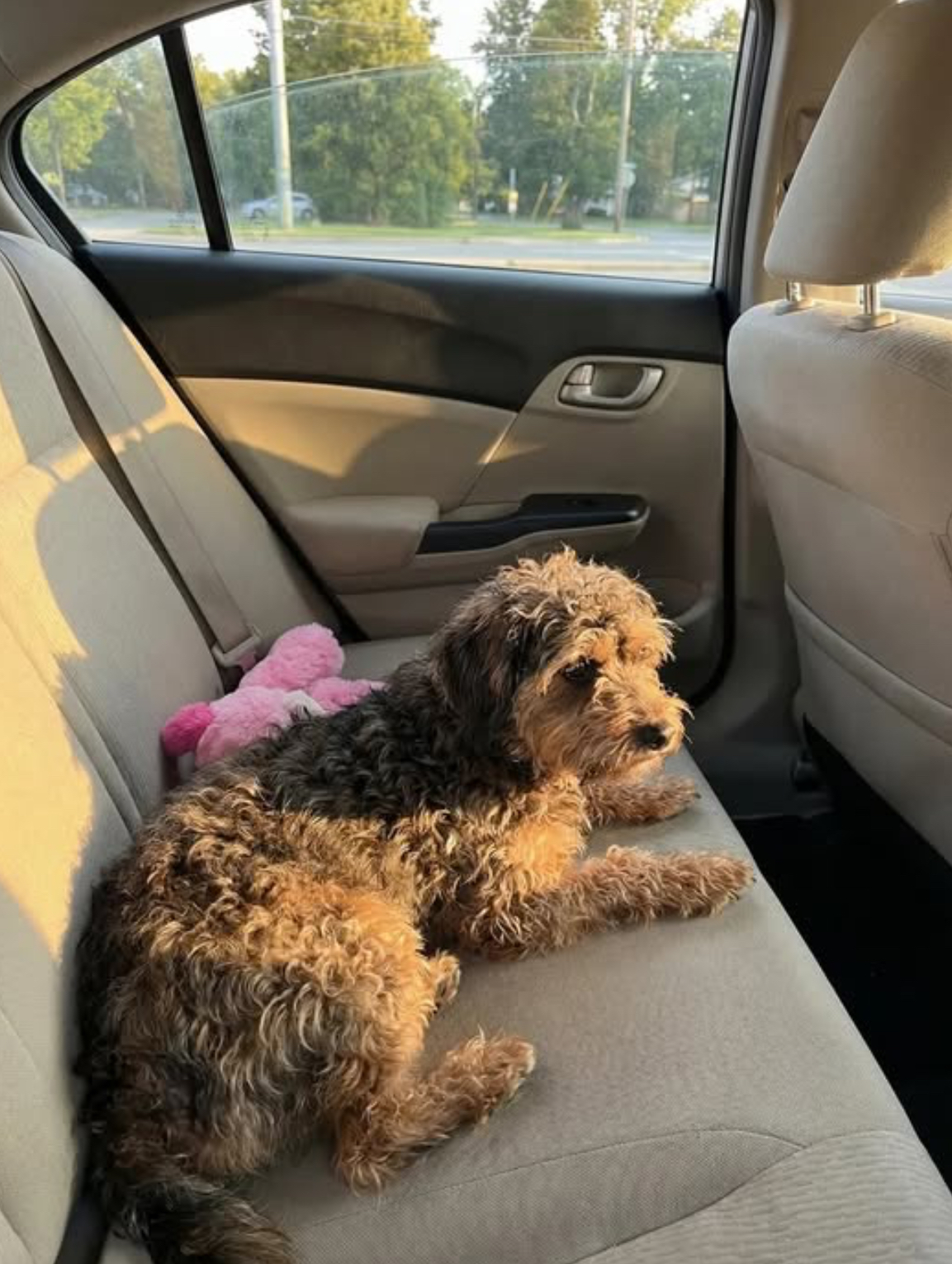
A volunteer lifted her gently and placed her in the car. The creature resting on the seat beside them barely resembled a dog at all. Her face was almost completely obscured by hardened knots of fur. Her paws were wrapped in mats that had fused with the dirt and debris she dragged with her. Her spine was prominent, her breathing thin. Somewhere under all of it, a living animal was waiting to be uncovered.
She arrived at Mac’s Mission, a rescue known for taking in animals with the most complicated needs. Staff members had seen cases of severe neglect before, yet there was a hush in the room when she was carried inside. They understood the amount of work, time, and patience required to give her a fair chance.
Grooming her couldn’t be rushed. Clippers ran slowly across the surface of the mats, which had grown so dense they resembled armor. With every removed section, the smell of old dirt and trapped moisture drifted into the air. Beneath the outer layers, her skin appeared pale and fragile, marked with the impressions of fur that had once protected her but had long since turned oppressive.
Piece by piece, the weight fell away. A shell of hardened hair dropped to the floor, leaving behind a dog far smaller and more delicate than anyone expected. It was impossible to tell exactly how long she had carried that burden. Months, certainly. Possibly years. What mattered most was that she no longer had to.
Her face told another story. One eye was gone, likely lost to an untreated injury or infection well before her rescue. The remaining eye watched the team with a quiet alertness. It held neither fear nor trust, only a vague awareness that something unfamiliar was happening and that resisting would cost energy she didn’t have.
Once freed from her mats, she was wrapped in warm blankets and offered food. She approached the bowl with careful, hesitant licks, unsure whether the meal was truly meant for her. Every motion was cautious. Every bite carried the urgency of someone who had gone without for far too long. When she finally finished, her head slipped sideways, and she drifted into a deep, unguarded sleep.
That first rest lasted nearly an hour. It wasn’t the restless dozing of an animal on alert. It was the full surrender of a body that had been carrying too much weight, literal and emotional, for too long. Her breathing steadied, and her thin frame softened against the blanket. For the first time in years, she slept without the pressure of heavy fur pressing down on her.
In the following days, progress came quietly. When caretakers entered the room, she began to lift her head rather than shrink back. Her eye followed them with a slow curiosity. She allowed hands to rest on her back, accepting touch with the tentative willingness of a dog trying to understand the difference between attention and harm.
The team decided she needed a name that carried softness, something that marked the beginning of her new life rather than the bleakness of her past. They settled on Pear. It suited her understated presence, and it suggested something capable of ripening with care.
Her recovery unfolded in small, meaningful moments. She learned that meals came on schedule. She began standing straighter now that her legs were no longer strained by the weight of matted fur. Her tail, once trapped and immobile, started to twitch in response to gentle voices. The first full wag came weeks later, subtle but unmistakable. It signaled that she was not only surviving but beginning to feel the early flickers of trust.
Pear’s transformation wasn’t dramatic. There was no single day when everything changed. Instead, it was the accumulation of steady, careful healing. Old wounds began to fade. Her skin thickened and strengthened. New fur grew in soft patches along her back and sides. She discovered she could move freely. She discovered she could be touched without pain. She discovered she could sleep without fear.
The real turning point came when she stepped outside for the first time. The winter sun brushed her face, and she lifted her head fully toward it, her eye half-closed in what looked like relief. She stood still for a long moment, letting the light warm the skin that had been hidden for so long. Then she took a slow step forward, then another, and the team watching her from the doorway knew they were witnessing the quiet arrival of a dog beginning to live again.
Pear’s story is a reminder of what neglect takes from an animal, but more importantly, of what compassion can return. Her healing was built on dozens of small acts of care, on patient hands and steady routines, on the simple idea that every creature deserves the chance to feel safe.
In choosing to trust again, Pear showed a kind of resilience that doesn’t need grand gestures or perfect conditions. It grows quietly in the presence of kindness. It strengthens with every gentle touch. And in her case, it led her from the edge of a road to the beginnings of a life defined not by what she endured but by what she finally received.
That is where her story truly starts.